Network Tokens, Passive Stablecoin Yield Bans, and More: Parsing the January 2026 Digital Asset Market Clarity Amendment

Executive Summary
The January 2026 bipartisan manager’s amendment to Senate Banking Committee crypto market structure legislation (renamed Digital Asset Market Clarity Act from Responsible Financial Innovation Act) marks a meaningful departure from the September 2025 draft. Key changes include: the creation of a distinct “network token” category separate from ancillary assets; the elimination of the proposed Section 105 investment-contract rulemaking; the replacement of voluntary self-certification with a rebuttable, presumptive certification framework; the addition of broader retroactive safe harbors for pre-effective-date transactions; and the introduction of more explicit anti-evasion provisions. Taken together, these revisions offer clearer statutory pathways for token projects while preserving regulatory leverage in ways responsive to Democratic enforcement concerns.
Thanks for reading Crypto Law Tactics & Observations! Subscribe for free to receive new posts and support my work.
Notwithstanding these structural changes, the provision most likely to attract sustained attention is the banking-backed language sharply limiting stablecoin reward programs offered by digital asset service providers- a constraint that may prove more consequential in practice than any of the bill’s definitional reforms.
1. Definitional Restructuring
September 2025 Approach
The September draft used a single-tier framework centered on “ancillary assets,” defined as:
“an intangible asset, including a digital commodity, that is offered, sold, or otherwise distributed to a person pursuant to the purchase and sale of a security through an arrangement that constitutes an investment contract.”
This definition tied the token’s classification directly to the existence of an investment contract arrangement at the time of distribution.
January 2026 Approach
The new version introduces a two-tier framework with distinct concepts:
1. Network Token: “a digital commodity that is intrinsically linked to a distributed ledger system and that derives, or is reasonably expected to derive, its value from the use of such distributed ledger system.” Network tokens are “treated as a non-security solely for purposes of the Federal securities laws.”
Note: A digital commodity is not disqualified from being a Network Token “due to the granting of economic interests or voting capabilities with respect to a distributed ledger system or its decentralized governance system.”
2. Ancillary Asset: “a network token, the value of which is dependent upon the entrepreneurial or managerial efforts of an ancillary asset originator or a related person.”
Practical Implications
• Network tokens (which align with the “Digital Commodity” definition in Clarity) now have an independent pathway to non-security status based on their functional relationship to the network, not solely the offering mechanics
• The “intrinsically linked” test focuses on whether the token is “directly related to the functionality or operation of the distributed ledger system”
• Governance rights and economic interests in a decentralized governance system explicitly do not disqualify network token status
• Protocol fee switch proposal delivering economic rights (see below) to token holders in a distributed ledger system likely to be a non-security transaction, whereas a proposal to deliver non-protocol revenue (e.g. Labs’ front-end fees) to holders likely to remain at risk of being deemed a securities transaction.
• In sum:
- Token (bestowing no economic rights) the value of which is not dependent on ancillary asset originator/related person = Network Token (non-security)
- Token (bestowing no economic rights) the value of which is dependent on an ancillary asset originator/related person = Ancillary Asset (security, subject to new exemption)
- Token bestowing economic rights in a Person = security
- Network token bestowing economic rights in a distributed ledger system or its decentralized governance system = non-security
- All where “economic rights” = an investment contract or profit-sharing agreement that represents, gives the holder, or is substantially economically or functionally equivalent to:
- A debt or equity interest, or an option on a debt or equity interest, in a person.
- Liquidation rights with respect to a person.
- An entitlement to, or a reasonable expectation of, an interest, dividend, or other payment, or direct or indirect transfer of value, from a person (other than a decentralized governance system).
- An express or implied financial interest in (including a limited partnership interest or interest in intellectual property of), or provided by, a person (other than a decentralized governance system).
2. Certification Process: From Voluntary to Presumptive
September 2025 Draft: Voluntary self-certification
- Originator may submit written self-certification that asset does not provide disqualifying financial rights
- 60-day deemed approval period
- No adverse inference from failure to certify
January 2026 Amendment: Rebuttable presumption framework
- Network tokens are presumed to be ancillary assets unless originator certifies otherwise
- 60-day deemed approval for non-ancillary certification
- SEC Commission vote required to deny
- Designated SEC office to support certification process
Key Change: The shift from voluntary to presumptive creates a default classification pathway. Projects must affirmatively certify to escape ancillary asset treatment and its associated disclosure requirements.
3. Investment Contract Rulemaking (Section 105): Removed
September 2025 Provision (Now Removed)
Section 105 required the SEC to adopt rules within 2 years defining “investment contract” with specific statutory criteria, including:
• Investment in an “enterprise or venture”
• Express or implied promises of “entrepreneurial or managerial efforts”
• Expectation of profits from such efforts
• Explicit removal of “commonality” requirement
• Efforts must be “post-sale and essential” (not ministerial/technical/administrative)
January 2026 Approach
Section 105 has been removed entirely from the bipartisan amendment. The new Section 105 addresses “Financial Interests of Ancillary Assets” rather than investment contract rulemaking.
Why This Matters
NASAA (state securities regulators) specifically requested removal of Section 105, arguing it would “upend decades of securities law” and add “so many elements and conditions to the investment contract analysis that form, not substance, will determine whether” enforcement applies. The removal addresses a key Democratic concern while preserving the Howey framework judicially.
4. Gratuitous Distribution Safe Harbors: Significantly Expanded
Both versions exempt “gratuitous distributions” from securities treatment. The January 2026 version substantially expands enumerated safe harbors:
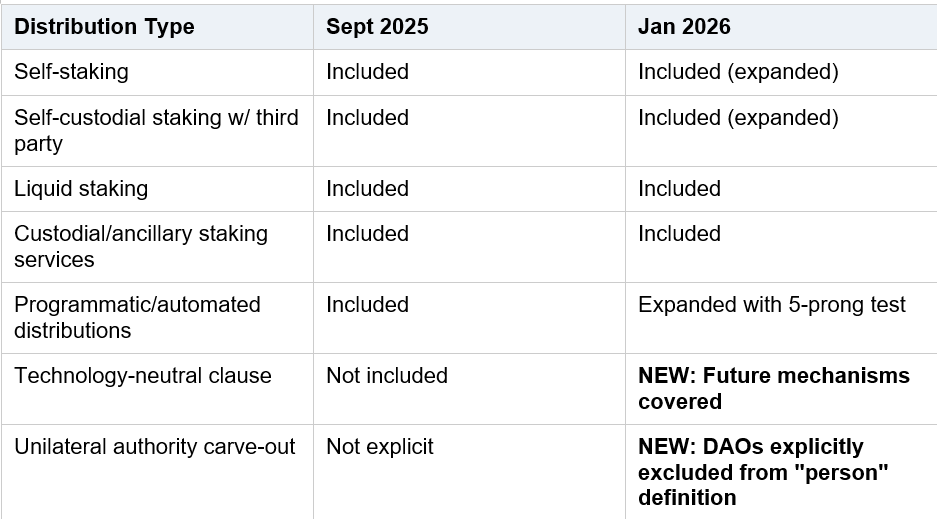
New Five-Prong Test for Programmatic Distributions: (i) public, transparent, rules-based parameters in open-source code; (ii) direct programmatic result of verifiable network participation; (iii) proportionate to contribution; (iv) value arises from decentralized participation, not single-entity discretion; (v) no unilateral modification authority.
5. Payment Stablecoin Rewards
This is the issue garnering perhaps the most attention. The new Section 404 is significant, creating a distinction between prohibited interest payments and permitted activity-based rewards:
Prohibited: Digital asset service providers (i.e. exchanges, wallets and platforms) cannot pay “any form of interest or yield (whether in cash, tokens, or other consideration) solely in connection with the holding of a payment stablecoin.”
Permitted Activity-Based Rewards: The prohibition does not apply to incentives connected to:
- Payments, transfers, remittances, and settlement
- Use of wallets, accounts, platforms, or blockchain networks
- Loyalty and promotional programs
- Subscription-based incentives and rebates
- Providing liquidity or collateral
- Governance participation
- Validation/staking
- Broader ecosystem activity
Why This Matters: This addresses the so-called interest loophole in GENIUS. GENIUS prohibits issuers from directly paying interest, but didn’t address third-party platforms offering rewards. The new language reflects a compromise floated last week by Democratic Senator Angela Alsobrooks, one of the key negotiators. Under Alsobrooks’ proposal, a crypto exchange can offer yield on stablecoins if the customer takes certain actions, such as selling their stablecoins, but cannot offer such rewards for stablecoin balances sitting in an account.
Essentially: passive yield = prohibited; active participation rewards = permitted. This appears to be the bipartisan compromise attempting to balance bank concerns about deposit flight against crypto platform business models dependent on stablecoin rewards. Unsurprising, early crypto industry responses are uniformly negative.
Practitioner Note: While both sides treat the issue as a red line, and this language is largely viewed as a loss by the crypto industry, it remains unclear (to me) whether the new Section 404 truly eliminates DASP stablecoin rewards. Absent further rulemaking, it appears clear to me that creative architects will be able to design “uses” and loyalty programs that are not “solely” dependent on passive holdings to deliver stablecoin rewards in a compliant manner.
6. Retroactive Treatment: New Section 4B(k)
The January 2026 amendment adds Section 4B(k), “Transactions Prior to Effective Date,” which provides:
• Primary Transaction Safe Harbor: Neither SEC nor private plaintiffs may pursue Section 5 or 12(a)(1) violations for pre-effective date ancillary asset distributions, provided the originator complies with transition disclosure requirements
• Secondary Market Safe Harbor: Secondary transactions in network tokens (by non-originators/non-underwriters) are deemed not securities transactions retroactively
• Fraud Carve-Out: Anti-fraud and anti-manipulation authorities preserved
• No Inference Clause: Retroactive treatment “may not be construed as an admission, acknowledgment, or inference of liability” for pre-effective date conduct
Practitioner Note: This provision effectively provides amnesty for past token distributions that would qualify as ancillary asset/network token offerings, subject to transition disclosure compliance. Projects with outstanding SEC investigations should analyze whether this safe harbor applies.
7. Anti-Evasion Provisions: New Section 4B(m)
The January 2026 version adds robust anti-evasion rules in Section 4B(m):
- “Form, label, and written documentation” not dispositive
- SEC may consider “totality of facts and circumstances” and “principal purpose” of arrangements
- Factors that may indicate evasion (non-dispositive):
- Removal of disqualifying financial right, re-introduced through related person or controlled vehicle (foundations, DAOs, labs)
- Circular or non-commercial value flows designed to simulate network utility
- Timing of steps to trigger/delay certification without material circumstance change
Safe Harbor: Evasion shall not occur if transaction entered for “legitimate business purpose” without principal purpose of circumvention.
8. Other Notable Changes
Forward-Looking Statement Safe Harbor (New)
Section 4B(j) creates liability protection for forward-looking statements (projections, development milestones, system adoption, market conditions) if: (1) identified as forward-looking; and (2) accompanied by meaningful cautionary language. This mirrors public company safe harbors.
Fiduciary Obligations (New)
Section 4B(p) clarifies that nothing in the bill limits fiduciary duties of originators, directors, or officers under state law, or duties owed to customers/clients/shareholders under federal or state law.
Regulation Best Interest / Investment Adviser Duties (New)
Sections 4B(q) and 4B(r) explicitly apply Reg BI to broker-dealer recommendations regarding digital commodities, and extend investment adviser fiduciary duties under Section 206 of the Advisers Act to advice regarding digital commodities.
Regulation Crypto Offering Limits
• September 2025: $75M per year or 10% of outstanding, $150M aggregate lifetime cap
• January 2026: $50M per year or 10% of outstanding, $200M aggregate lifetime cap
Expanded Software Developer Protections and Preservation of Self-Custodial Rights
- Blockchain Regulatory Certainty Act (Sec. 604)
- Keep Your Coins Act (Sec. 605)
Net effect: Jan. 2026 upgrades developer/self-custody protections from “safe harbor sidebar” to more fulsome coverage with named acts.
Title Structure Changes
The January 2026 version reorganizes titles and adds new provisions including: Title III (DeFi), Title VI (Software Developers), Title VII (Bankruptcy), Title VIII (Customer Protection). The DeFi title addresses application layers, mixers/tumblers, offshore stablecoins, and cybersecurity standards.
Conclusion
The January 2026 bipartisan amendment reflects legislative compromise and progress on token classification-the network token pathway, enhanced gratuitous distribution safe harbors, and retroactive treatment provisions represent meaningful wins for projects seeking regulatory clarity. The removal of Section 105 preserves judicial flexibility on Howey while the new anti-evasion provisions signal that substance-over-form enforcement remains intact.
The stablecoin rewards issue, however, threatens to overshadow these gains. Whether Section 404’s “solely in connection with holding” language survives markup intact, or whether Coinbase and others make good on withdrawal threats, may determine whether this bill reaches the President’s desk before midterm dynamics take hold.
For practitioners advising token projects, the immediate focus should be threefold: (1) mapping existing token economics against the new disqualifying financial rights criteria, particularly the decentralized governance system carve-out; (2) evaluating whether pre-effective date distributions qualify for Section 4B(k) safe harbor treatment; and (3) for platforms offering stablecoin rewards, stress-testing program structures against the activity-based exemptions before assuming the worst.
The markup is coming. Expect amendments.